
Cry Proper
On complaining, pleasure and enjoyment, and the Ten of Swords

When is complaining too much? And how does complaining transform into compassion? I am a shameless complainer. I say “I hate this and that” without any measure and I love shittalking about the place I live in and people (this is probably more gossip than anything else), and protest about micro and macro injustices. But I noticed that it is very difficult for me to transform the complaining into something else. It is as if I take it for granted, as a habit, instead of as a critical and bonding tool — which it is!

On complaining
Last summer, I was talking with a friend about Miranda July’s book and sexuality in older people and I said I expected to keep having orgasms or, at least, enjoy sex after menopause. This is the gift of All Fours: the possibility of imagining pleasure beyond age.
My friend told me there is a podcast where people send their gossip and grievances to be read publicly but anonymously. I guess a kind of confessional. In one of the episodes, a grandchild complained that their grandma was very promiscuous and having sex with numerous fellow residents in her retirement home. I thought what an annoying grandchild! But what an amazing grandmother! And absolutely praised this image of retirement homes as summer camps where the elderly flirt and have night sex escapes.
My friend and I had no idea who these people were but at that moment, it gave us a lot to talk about. The producers of this podcast clearly know what people want to listen to, which is obviously the trash that fills us with dissatisfaction and pain.
Criticizing each other we not only get to know more about our values (hating elderly sex), our condition (probably repression), and enunciating what hurts us (unreceived or unexpressed love). Complaining can be comical like the first time you listen to Fran Lebowitz talking about New York City. I actually think that New York City is branded as “the ultimate bitch city.” As a place filled with many things and features to shittalk about and yet love which has given us many good pieces of art like the song New York, I Love You But You're Bringing Me Down. The book Goodbye to All That. The recently published essay by Büşra Erkara: Emotional Real Estate and the City. Or one of my favorite substacks i hate these people.
Complaining can help put things into perspective or find a solution —like complaining about your boss to your colleague and finding a way to communicate better or leave that stupid job. Complaining can be lyrics for a choir united in a collective protest. Complaints can expose centuries of academic abuse while also revealing the uncomfortable place that we take as complainers, this was the work of Sarah Ahmed in her book Complaint!
All in all complaining is powerful, we love it and should use it!
Pleasure and Enjoyment
Yet, I think sometimes I go too far. I know that there are external factors for me not to feel at the best right now: precarious job contracts, money, frustration with time, tiredness. But it is also an attitude towards moments of crisis. The first thing that comes to mind —also because it had come up in therapy— is my experience with constant grumbling at home in my childhood, because it was very present, verbally and non-verbally. Grievances that never changed or incited a change, or empowered anyone. They were rather grievances that perpetuated a situation of hopelessness and lack of responsibility.
So when my partner tells me I’m complaining too much I know he means it and he has thought about it and I appreciate it because, why in the hell would I want to have my loved one be overwhelmed by my complaints? Why would I do that to myself? Why would I go against my desires?
So I started to dig into it and as it usually happens to me, I began to receive signals. The first one was when I started reading Política del Malestar de Alicia Valdés. I hope it is soon translated to English because it is an absolutely necessary commentary on contemporary politics and desire from the perspective of psychoanalysis. All written in a very accessible language.
In the first chapter, Valdés draws a differentiation that I think is key here. The difference between pleasure and enjoyment (placer y goce). Roughly, pleasure is to feel good about something: being in the sea, the sun, the company of significant others. Enjoyment, which could also be translated as rejoicing or to take delight, as in to take pleasure from something. The pleasure is caused by this “something.”
To explain enjoyment (goce) Valdés uses as an example a situation where a friend asks for advice from another friend. The friend offers their advice and what they would do. Days later the friend who asked for advice says that the situation they asked for didn’t go well and that they didn’t use their advice. The friend who gave the advice then says “I told you.” And here, in this “I told you” is the enjoyment of the friend.
This is not to say that we feel joy when we see others fail but there is a kind of pleasure that draws from situations of stagnation, familiarity and also just pure constant complaining. If a complaint isn’t followed by compassion and understanding of the conditions that hurt us, of our own desires, and a critical position to break through a situation, to propose alternatives. Why would one keep complaining if not to enjoy complaining itself?
The Ten of Swords
The second and third signals for me to see the downside of complaining happened almost all at once. One of them I saw on my way back from the grocery store. I noticed a graffiti that read “Cry Proper” (image above). It sounded literary and jarring. Perhaps it was the contrast between the message and the steel bridge. It was definitely a complaint. Someone upset enough to go up there —probably risking their life— and loudly tell someone else or the world in general to fucking genuinely cry for real! And I took it in. I thought yes, I am among those whining souls that do groceries and take public messages as personal.
I guess the last signal that pushed me to write about this and further understand how my complaints were disempowering me, was not really a signal since I unconsciously looked for it.
After seeing the “Cry Proper” graffiti, I went home and did a tarot reading by myself. I asked the cards about the new year and work and I got average good cards. Then I asked about my relationships and I got the Five of Disks, which in the Thoth Tarot deck — the one I use— means Worry. In the book Tarot. Mirror of The Soul, Gerd Zeigler says this about the card:
(...) your inner wisdom admonishes you to do something. The problem is that you remain idle while at the same time tormenting yourself with your entangled thoughts.
At first this didn’t sound great, but then Zeigler adds that this card also expresses an opportunity to free yourself and suggests to draw another card to see what will change when I “open a discussion or allow myself to look bravely at the truth of the situation.”
Then it got really nasty! I drew the Ten of Swords which means Ruin! Yes! Great!
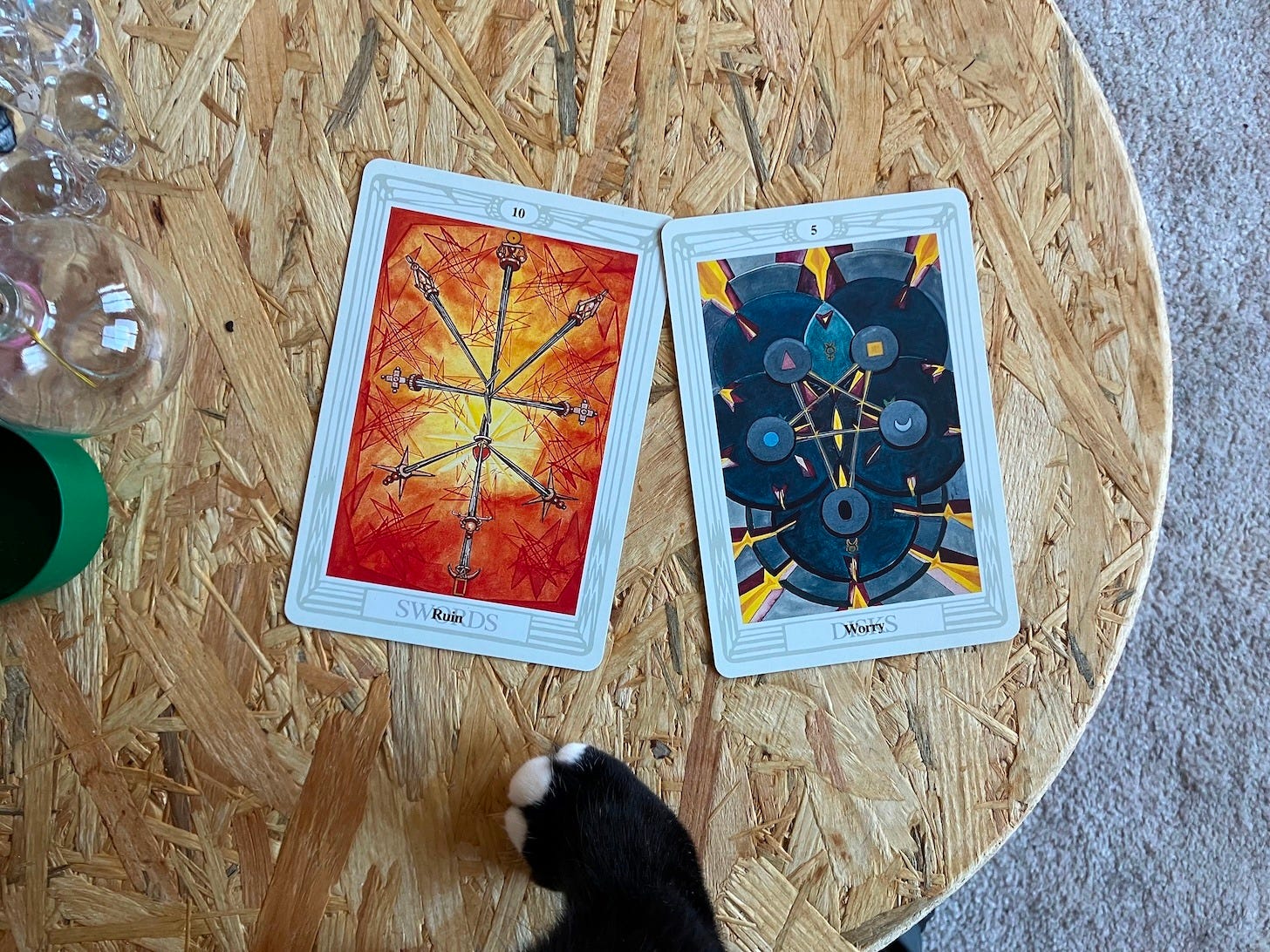
Zeigler writes:
This card shows the destructive power of constant negative thinking. It is an image of insanity, a confused uproar of soulless mechanisms. Even the last remains of joy of life (Sun), love for yourself and others, as well as existence (heart) threaten to fall prey to this negativity.
Negativity disrupts and destroys the soul's striving toward harmony and balance.
The situation is also a threat to your external conditions. This may lead to financial ruin, or the loss of other meaningful possessions or possible needs.
Then Zeigler literally says “reprogram yourself.” Could it be more dramatic? What have I done to myself?
Thank god I found some more information on the internet which explained that the Ten of Swords is about recognizing the fears of “ruin” and “ends” and turning them into positive terms. The interpretation of this card in the Rider–Waite Tarot deck according to teacher and reader James Ricklef was:
This card’s suggestion of an end to over-analysis points out a beautiful interpretation of it. … We must remember that this card is not in the suit of Pentacles, so it is not primarily about physical manifestations. Instead, it is in the suit of Swords, which is concerned with thought (among other things). Thus, we may view the fate of the man on this card … symbolically as the end of the tyranny of what is called “Monkey Mind.” As a result, this card says that when we finally put an end to the tyranny of our thoughts (which should be our servant, not our master as they usually are), we will find silence and stillness … and bliss.
This calmed me down a little and I took it as a piece of advice which weirdly also spoke to my previous post On Ruminating. And if I wasn’t looking for new year’s resolutions now I had one: Cry Proper!